Derived from the fusion of different worlds, the Peugeot Prologue HYmotion4 concept car lifts a corner of the veil on a new type of cross-over. Anticipating future trends, this concept is a formidable laboratory of innovative ideas at many different levels: its architecture, its style, its interior ambience, its modularity, its original high-tech equipment, and also the next generation HDi FAP hybrid technology called "HYmotion4" including 4 wheel drive. With a diesel engine driving the front wheels and an electric motor powering the rear wheels, this spacious yet compact 147 kW (200 bhp) car generates a particularly low level of CO2 emissions: 109 g/km in the combined cycle, or zero in electric only mode!
The Peugeot Prologue HYmotion4 is a pioneering concept car heralding the arrival of a compact and spacious cross-over in the Peugeot range. It is positioned at the crossroads between different categories and body shapes...
This concept car also demonstrates progress made towards an ambitious and promising goal: an electric/ diesel power plant with a dual transmission system which opens up the possibility of 4 wheel drive: a technology known as "HYmotion4".
In a sense, a "full hybrid" vehicle:
= Hybrid on account of its exterior architecture, with a body carrying SUV, MPV and hatchback genes...,
= Hybrid on account of its style, which blends power and protection, strength and elegance, leisure and prestige with a real sense of dynamism,
= Hybrid on account of its unexpected interior, which combines the ambience of a top-of-the-range hi-tech Coupé with practical and efficient modularity.
= Hybrid on account of its dynamic specification since, thanks to the Marque's expertise and the technologies employed, this "tall single compartment" vehicle is capable of ride qualities worthy of a saloon and still offering an original driving experience.
= Hybrid on account of its technology, electric (at the rear) and HDi FAP diesel (at the front), both engines operate independently or together for a maximum power of 147 kW (200 bhp) and a maximum torque of 300 Nm at the front and 200 Nm at the rear.
= Hybrid on account of its transmission which allows for 4 wheel drive, combining safety and driveability with a particularly efficient environmental performance (combined fuel consumption of 4.1 litres/100 km and CO2 emissions of only 109 g/km, or zero in electric only mode).
The Peugeot Prologue HYmotion4 concept car proposes innovative, high-performance solutions all ensuring maximum versatility. It offers a unique blend of driveability, safety, adventure and originality, while at the same time showing respect for the environment. An environmentally-friendly hybrid, in step with the times and aligned with the aspirations of its many potential customers.
Genesis of ideas: exploiting benefits to the full
In terms of new concepts, Peugeot has always been a hugely creative car manufacturer. In the recent past, this has resulted in numerous concept cars with avant-garde architectures, as well as innovations which were later adopted on production vehicles. All these concepts, however, were clearly aimed at users in search of driving pleasure and the very best that technology has to offer. The creativity of stylists and engineers has always given rise to strong, modern and distinctive concepts in the Peugeot range, offering multiple benefits in terms of motoring enjoyment and day-to-day practicality. Examples include the CC (coupe + cabriolet), the SW (intelligence and brightness in the world of the estate), or the 307 and 308 (modern hatchbacks with a semi-tall architecture).
Convinced that the future of the motor car will necessarily involve the hybridisation of many different concepts, and helped in this by technological innovations, Peugeot teams are currently working on an innovative vehicle destined to conquer new markets. The Peugeot Prologue HYmotion4 concept car perfectly illustrates this approach.
Alert to global sociological and economic trends, the Peugeot Prologue HYmotion4 concept car anticipates the expectations and preferences of potential customers. These customers will be aware of world issues but also anxious to preserve their achievements and values. By positioning itself at the point of convergence of several existing body shapes, therefore combining the numerous benefits of each style, this concept car explores new territory, proposing a modern and versatile offer with a high level specification based on advanced technology.
Style: power that protects
Peugeot styling has always had a strong and dynamic personality that is easily recognisable regardless of a particular range or successive generations of models. It is nonetheless constantly changing. Developments come to the fore, some more marked than others, according to the life cycle of the vehicle and, above all, its category.
Here, exterior style successfully evokes the vehicle's highly innovative content.
In keeping with the car's overall design, its style expresses itself through original proportions and new vectors of balance.
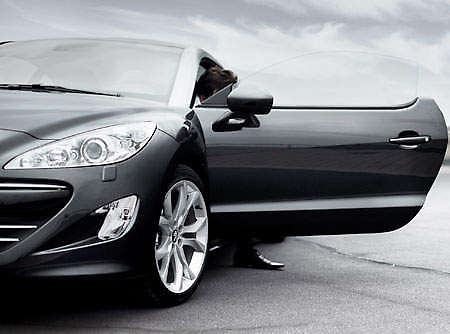
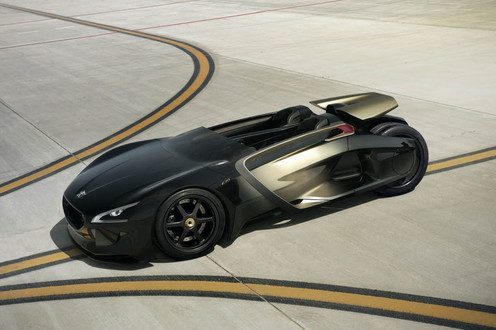
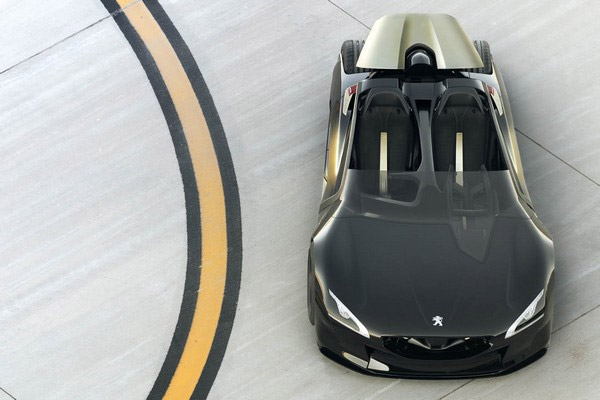
At the front, the Peugeot genes adapt to the car's generous volumes while setting it apart from what has gone before. The streamlined front headlamps immediately call to mind a renewed, dynamic and reassuring expressiveness. The single air intake helps create the effect of a high-status off-roader, with a front grille reminiscent of the world of the SUV. The lower front panel strengthens this "off road" appeal with its black lacquered bumper following the contours of the lights.
From the side, the rising window line has an upper section enhanced by chrome. This accentuates the imposing height of the waist line and, thanks to the majestic 18'' wheels and sculpted wings, contributes to the strong sense of robustness which spreads through the entire vehicle.
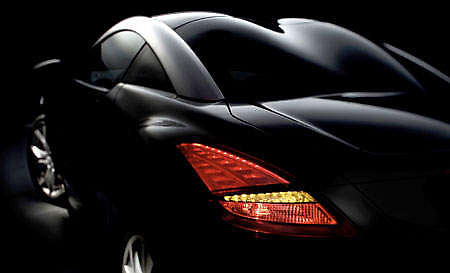
At the rear, the attractively rounded wings are moulded to the shape of rear lights, here given a particularly hi-tech finish. The originality of this design adds to the perception that the vehicle is firmly planted on the road. Here too, the presence of a "hobby" tailgate and large black protective mouldings in the lower section, illustrate the "Outdoor" spirit of this concept car.
In the final analysis, the style of the car creates multiple impressions: inner strength, contained power, controlled dynamism...
This protective style, rewarding and reassuring, appeals not only because of the richness of these connotations, but also because of the new light in which it casts the motor car. A breath of fresh air enhanced by the "polar" grey body colour which has a textured finish reminiscent of the skin of an imaginary reptile.
Interior ambience: a strong statement
Continuing the theme of a hybridisation of styles, the passenger compartment becomes a new source of surprise and delight for the car's occupants.
Within the spacious design of the car's body, the driver's seat evokes the world of the prestige coupé and bears a strong resemblance to an aircraft cockpit. An uncluttered fascia panel, controls easily within hand's reach and an ergonomic centre console bordering the "pilot's" territory, are all combined with a dominant raised driving position: the driver, given VIP treatment, can enjoy the distinctive driving experience to which he aspires.
These qualities are echoed throughout the passenger compartment.
Hi-Tech refinement
Distinctive materials are used to emphasise the sense of fusion and explore new avenues of expression. Smooth leather is accompanied by full-grain leather, textured to represent the bodywork and its reference to the skin of an imaginary reptile. This creates a subtle contrast with the synthetic fur of an improbable animal covering the centre of the seat cushions.
The general ambience of light, bright grey, harmonises with the exterior colour, while turquoise visible stitching, echoing the displays and pictograms of the instrument panels, adds zest to this theme.
The overall effect is one of unity, both natural and clinical, animal and mechanical, physical and refined.
"Multiflex" interior: undreamt-of versatility
While giving the driver the promise of renewed driving pleasure, the Peugeot Prologue HYmotion4 concept car also has much to offer its other occupants.
They too will enjoy the passenger compartment with its original atmosphere, bathed in generous volumes of light dispensed by the immense panoramic glass roof. They also benefit from numerous storage spaces, particularly in the rear floor and the generous front centre console.
Providing added security for the front passenger, a solid handle on the centre console, helps to find the ideal position for a comfortable journey.
Thanks to its intelligent "Multiflex" interior, the Peugeot Prologue HYmotion4 can be converted to offer a very generous load carrying capacity. The lower tailgate flap, or "hobby", and the upper tailgate, open to reveal a boot in which the floor height can be adjusted very easily according to what needs to be carried.
From the boot, a special control can be activated to fold the second row seats instantly, as if by magic. Also benefiting from an ingenious folding front passenger seat, the Peugeot Prologue HYmotion4 offers a perfectly flat floor from the lower tailgate flap "hobby" to the fascia panel. This makes available a huge interior space that is very easy to load.
Also on the inside of the car, the hybridisation of concepts paves the way for undreamt-of possibilities...
Driving assistance: simple hi-tech equipment for enhanced safety and driving pleasure
Comfortably installed behind the wheel, the driver will discover equipment that makes passing reference to the world of aviation.
To ensure that the driver's eyes never have to leave the road, essential information is projected onto a retractable transparent display, similar to that of a fighter plane, which cleverly extends from the instrument panel binnacle. The settings for this Head-Up Display system can be adjusted by means of "Toggle Switches". These switches, placed at the top of the centre console, contribute stylistically to the interior ambience. They also control another original item of equipment: the "Distance Alert". As its name implies, this system helps the driver to maintain a safe distance from the vehicle in front, according to speed.
Another item of equipment gives the driver peace of mind: Measurement of Available Space (MPD), which measures the size of the space during parking and indicates whether or not parking is possible. Similarly, the Electric Parking Brake (FSE) coupled with Hill Assist, facilitates manoeuvring and, takes the place of a manual hand brake, optimising the available space.
Finally, a new generation satellite navigation system helps to guide the driver along his chosen route. This "WIPCom 3D" combines all the benefits of existing satellite navigation systems proposed by the Marque (particularly the new "WIPCom" featured on the new 407). It also includes a Juke-box function, combined with a hard disc, the Peugeot Emergency system (which alerts the emergency services and pinpoints the vehicle's location in the event of an accident), a GSM function and a USB connector... while new functions are also in evidence, such as the DVD player, the Bluetooth® system and a graphic interface which shows city buildings in "full 3D".
In terms of "vehicle dynamics", the ESP featured on the Peugeot Prologue HYmotion4 is coupled with a "Grip Control" system to ensure optimal traction. This "improved ASR" will deploy the car's 4 wheel drive to best effect when road conditions are less than perfect.
The HYmotion4: taking the hybrid concept to its limits
HYmotion4 technology, a magic formula that's elementary nonetheless: "Electric+HDi = 147 kW (200 bhp)+300 and 200Nm = 4 wheel drive+CO2 emissions of 109 g/km"
The Peugeot Prologue HYmotion4 concept car incorporates an incredibly innovative power train: HYmotion4 technology.
This name represents the hybridisation of a traditional engine (a 2.0 litre HDi FAP with a power of 120 kW / 163 bhp) with an electric motor offering a maximum capacity of 27 kW (37 bhp). This unit is characterised by an original mechanical layout, since the HDi engine is situated in its usual place under the bonnet and drives the front wheels, while the electric motor, placed at the rear under the boot floor, drives the rear wheels .
Therefore, there are no mechanical components between the front and the rear, everything being controlled electronically ("by wire"), allowing optimisation of space in the passenger compartment.
The end result is a 4-wheel drive vehicle offering reduced fuel consumption in the combined cycle of 4.1 litres/100 km and CO2 emissions of 109 g/km!
None of which detracts from the car's performance, since with a maximum power of 147 kW (200 bhp) and a maximum torque of 300 Nm at the front and 200 Nm at the rear, acceleration and in-gear acceleration are at the level of what could be obtained with a single 2.2 litre HDi FAP dual-turbo engine.
Here too, the hybridisation of technologies makes it possible to combine the benefits of a roomy car with 4-wheel drive, while at the same time offering environmentally-friendly credentials.
HDi FAP hybrid: research goes on
To tackle the problem of greenhouse gas emissions, and with the prospect of fuel prices rising ever higher, the Peugeot Marque has made the reduction of fuel consumption and CO2 emissions a key facet of its product policy.
Already today, Peugeot is making a real contribution to the PSA Peugeot Citroën group's position as a world leader on the market of vehicles emitting less than 120 g/km of CO2.
To retain its leadership, the group has announced that it is working on a range of different technologies, including:
= Large-scale "micro-hybridisation" with a STOP & START system, which will equip more than a million of the group's vehicles by 2011.
= HDi hybrid technology, which combines an HDi diesel engine with a particulate emission filter (FAP), with STOP & START and also with an electric motor operating in parallel to the diesel engine. This technology breaks with the past and allows gains in fuel consumption and emissions in the order of 35 % compared to a traditional diesel engine which is already highly efficient in thermodynamic terms (fuel consumption is reduced by 30 % compared to a petrol engine of the same capacity).
Several technological demonstrators have enabled the group to develop and increase its experience in this diesel hybrid technology.
These demonstrators have capitalised on the group's historic advance in the field of electric cars and, naturally, on its widely acclaimed expertise in the field of diesel engines featuring HDi FAP technology. The HDi hybrid therefore combines the exceptional efficiency of a HDi FAP diesel engine, here used in its optimum operating phase, with the addition of an electric motor particularly well suited to urban driving.
= January 2006 saw the unveiling of a 307 Hybrid HDi equipped with a 1.6 litre HDi FAP 66 kW (~ 90 bhp) engine and an electric motor offering a maximum power of 23 kW (31 bhp). Its fuel consumption in the combined cycle was 3.4 litres/100 km equating to CO2 emissions of 90 g/km for a level of performance equivalent to that of a 1.6 litre HDi 80 kW (~ 110 bhp) engine,
= In March 2006, with a view to offering cars that are both attractive and environmentally-friendly and taking the notion of driving freedom to a new level, a Peugeot 307 CC Hybrid HDi was presented. This car features a 1.6 litre HDi FAP 80 kW (~ 110 bhp) engine and an electric motor providing a maximum power of 31 kW (42 bhp), giving the vehicle a fuel consumption in the combined cycle of 4.1 litres/100 km and CO2 emissions of 109 g/km, with a level of performance equivalent to that of the 2.0 litre HDi FAP 100 kW (~ 136 bhp) engine,
= In September 2007, a new step was taken in terms of system performance and the optimisation of components with a view to possible industrialisation. The 308 Hybrid HDi 1.6 litre HDi FAP 80 kW (~ 110 bhp) engine and its electric motor delivering a maximum power of 23 kW (31 bhp) offered a combined cycle fuel consumption of 3.4 litres/100 km and CO2 emissions of 90g/km.
The Peugeot Prologue HYmotion4 concept car constitutes a new and decisive step towards the marketing of this innovation.
This car's technology represents a major advance in terms of customer benefits.
Firstly it benefits from experience acquired from previous technological demonstrators, keeping the same high level of environmental efficiency (a 35 % improvement compared to that obtained with a 2.2 litre HDi FAP dual-turbo engine).
Secondly, it offers a level of performance of the highest order thanks to its potential power of 147 kW. Finally, its innovative design allows the possibility of 4 wheel drive, benefiting safety and driveability, with no adverse effect on the design of the engine compartment or the interior passenger space.